Dear readers,
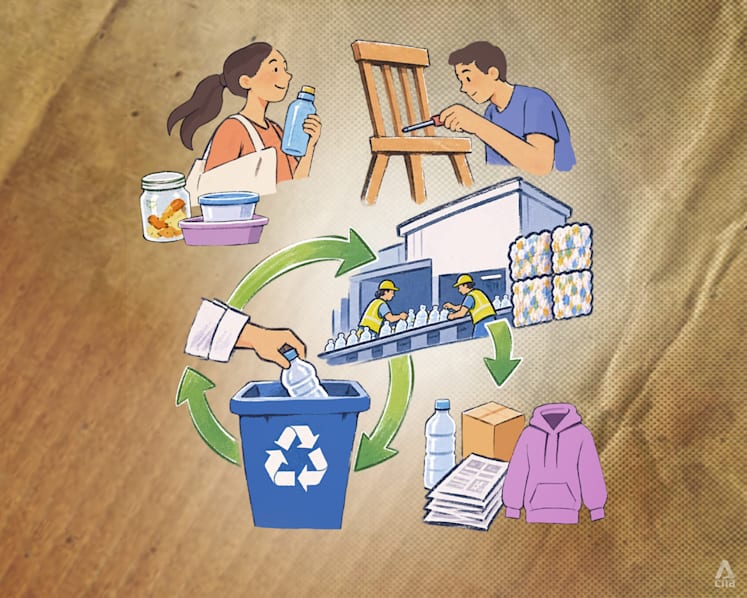
At university, 28-year-old Clara Lim was a committed greenie, bringing reusable containers for takeaway meals and sorting her trash for recycling.
But since she started working, she's become less consistent, because they take effort and sometimes she has no time.
Similarly, 29-year-old Scott Lee occasionally recycles cardboard boxes from online purchases, but otherwise disposes of recyclable items with his ordinary rubbish.
Partly, he said, it's because his HDB block’s blue recycling bin is frequently full.
Their experiences reflect findings from a Mediacorp-commissioned YouGov survey of 3,558 respondents on Singaporeans' attitudes towards reducing, reusing and recycling.
While 85 per cent of respondents said they believe recycling is every individual's responsibility, only 55 per cent use blue recycling bins and 49 per cent used the beverage bottle and can return scheme at least weekly.
Beyond inconvenience, confusion over what can be recycled is another hurdle, and that knowledge gaps are wider among the young.
For instance, 42 per cent of Gen Z respondents (those born between 1997 and 2012) mistakenly believed ceramics could be recycled, compared with 33 per cent of millennials (born between 1981 and 1996) and 34 per cent of Gen X respondents (born between 1965 and 1980).
And 22 per cent of Gen Z believe, incorrectly, that food and liquids can be recycled, compared with 16 per cent of Baby Boomers (those born between 1946 and 1964), and the Silent Generation (born between 1928 and 1945).
So what will it take to bridge the gap between good intentions and action? CNA spoke to consumers and environmental experts to find out.
Yours faithfully,
Yasmine Yahya
Deputy Chief Editor, CNA Digital (Commentaries, Features, Lifestyle & Luxury)